Best AI Tattoo Generator
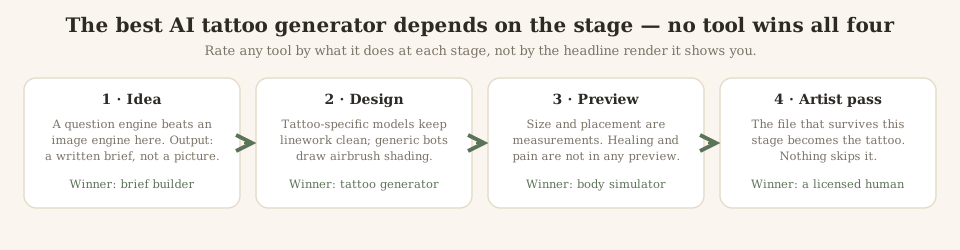
The best AI tattoo generator is a stage decision, not a brand: a question engine wins your idea stage, a tattoo-specific model wins the design stage, a body simulator wins preview, and a licensed artist wins the handoff — every single time. No independent benchmark tests tattoo output, so treat every top-ten list as an advertisement, then run the same four prompts on your own finalists below.
Why the “best AI tattoo generator” lists can’t answer their own title
Open the top ten results for this exact search and audit one thing: who wrote the list. Several are blogs by companies that sell a tattoo generator — and each places its own product near the top. That’s not a conspiracy, it’s the business model of the category. The structural problem is upstream: no independent benchmark scores tattoo output. General image-model leaderboards rank photorealism and prompt adherence — neither is a tattoo metric. A model can top a leaderboard and still draw a name in script that heals into a bruise.
So this page does the honest thing instead of a fake ranking: it splits the job into four stages (the one axis every tool actually differs on), gives you a scoring rubric, and links you to the exact test you can run on any finalist — including InkPreview, which wrote this page and is subject to the same four prompts.
Pick by Stage, Not by Brand
“Best” only means best-for-a-stage. Find the stage you’re stuck on; the right tool is usually obvious.
Idea — no image engine needed
If you don't know what to get yet, a generator is the wrong tool: it answers a question you didn't ask with pictures you didn't choose. The best tool here is a question engine that outputs a written brief — subject, placement, line volume. Specificity beats rendering power.
Best for stage 1: the idea engineDesign — tattoo-specific beats generic here
Once the brief exists, style-locked presets (fine line, blackwork, dotwork) draw cleaner linework than a general chat bot, which renders airbrush shading no needle can copy. Judge outputs on strokes you can trace, not on how lush the render looks.
Best for stage 2: run the same brief herePreview — the stage most 'best' lists skip
A design that scores perfectly on screen can still fail at 5 cm on a ribcage. The winning tool at this stage measures: centimetre size on your own photo, placement against joints, overlap with ink you already have. Any list that ignores this stage never inked anything.
Best for stage 3: body preview, to sizeArtist handoff — no generator wins this one
The file that reaches the shop is a redrawn one: letters re-typeset, micro-detail consolidated, composition fitted to your muscle. A stencil-ready line export and a size sheet shorten the consultation; the artist's pass is not optional. Tools that claim otherwise are selling the render.
Best for stage 4: clean line exportThe Four Criteria a Tattooable Output Must Pass
Run identical prompts into two or three generators and score the outputs against these — the same rubric our gallery uses to label its own failure modes.
Linework discipline
Zoom to final placement size. Continuous visible strokes pass; gradient mush fails — it heals as a grey smudge.
Negative space
Squint at the thumbnail. Packed black with clear breathing room survives; cluttered compositions only make sense fully zoomed.
Text fidelity
Every generator hides this one. Ask for a name in script. Garbled letters here guarantee an artist redraw.
Honest limits
The strongest signal isn’t output quality — it’s whether the tool tells you what it cannot do: aging, pain, anatomy, healed contrast.
The full ten-minute protocol — the exact four prompts, what each one exposes, and the pass bar — is on the generator page under “Don’t trust reviews — run the ten-minute four-prompt test”. It works on any tool, and we fail it in public where we fail it.
Frequently Asked Questions
What is the best AI tattoo generator for beginners?
One that asks you for four things and refuses to flatter the result. A beginner's failure mode is falling for a dense render that can't be needled. Use a generator that locks style presets (so you don't prompt-shop vocabulary), shows a real centimetre-size preview on your own photo, and tells you plainly which parts need an artist redraw. That means a tattoo-specific tool over a general image bot for stage one.
Is there a best AI tattoo generator app, or is web enough?
Web-first is the honest answer for most people. Store apps add an account wall, a store-priced subscription and update delays for no extra capability - the models run on the same servers. An app earns its place only for one job: live camera AR try-on in a shop consultation. For design drafts, placement sizing and downloads, a browser tool that runs free as a guest beats installing anything.
Which is the best AI tattoo generator free - what does 'free' actually include?
Free means four different things across the market: free to look (gallery only), free to generate but register to download, free credits that expire, and genuinely free with a stated daily allowance. Before comparing quality, compare that. Our tier-by-tier breakdown of what each free label hides lives on the free AI tattoo generator page - same engine, nothing gated on the preview.
Are the 'best AI tattoo generator' lists on Google trustworthy?
Mostly not, and you can spot it in one step: check who published the list. A large share of ranking pages are written by companies that sell a tattoo generator and place themselves at number one. That's not a tattoo-specific flaw - no independent benchmark scores tattoo output at all. So skip the leaderboard, run the ten-minute four-prompt test on three finalists, and trust your own eyes over anybody's number one.
What do people on reddit actually say about AI tattoo generators?
The recurring thread is artists complaining that AI designs carry more detail than skin can hold - packed micro-shading, hairlines that blow out, garbled lettering. That is a real limitation, and it applies to every tool on any list, ours included. The useful reddit signal is people sharing a prompt that failed and the redraw that fixed it. Take the complaints as the spec for what to check before booking.
Can the best AI tattoo generator put the design on my body?
Any good one should do stage three - placement - or you're only getting half a workflow. A real on-body preview composites the design onto your photo at a stated centimetre size, so scale and overlap with existing ink are measurable. What no generator's preview honestly shows: ten-year aging, pain at the spot, or how the line reads on your undertone healed. Judge tools on whether they say so.
What is the best AI tattoo generator from a photo?
The one that reinterprets your upload instead of filtering it. Drop the same reference into two tools: a copy-paste job returns your image with a texture applied; a tattoo-specific model rebuilds it as continuous linework a machine can follow. High-contrast, single-subject photos give the fairest comparison. If your dog comes back as a Pinterest filter, that tool doesn't do photo-to-tattoo - it does photo-to-photo.
Keep Going
What “Free” Actually Includes
The five meanings of free, tier by tier — and our exact guest allowance.
Run the Four-Prompt Test Here
Generate the fine-line, blackwork, photo and script prompts yourself — 3 a day, no sign-up.
Stuck Before Stage 2?
Three questions to a written brief — the stage-one tool the rankings never mention.