Script Fonts for Tattoos — See Your Word in 12 Real Script & Cursive Faces
“Script” in a tattoo search means four different lettering families at once — joined cursive, brush, old english, handwriting. This page renders the real kind of each lane: twelve open-licensed script and cursive typefaces (wedding, copperplate, casual, brush and handwriting) drawing the exact word you type, live in your browser, free, no account. Many pages selling “script tattoo fonts” actually hand you Unicode symbols that look like script but are not fonts at all.
Rendered with real open-licensed typefaces, drawn in your browser. Nothing is uploaded, nothing is stored. Loading fonts…
Found the one it should be? Screenshot it at your slider size, then put the lettering on a photo of your skin — screen size and skin size are different questions — and hand both files to your artist via the stencil generator.
“Script” Is a Family, Not a Font — Which Lane Are You Actually In?
Autocomplete proves the ambiguity: people type script and mean cursive, and also mean chicano brush, old english and handwriting — four lettering families that age and stencil completely differently. Font-list pages blend them into one gallery; nobody tells you which search you are making. Here is the split, with each lane’s real dropdown phrase underneath.
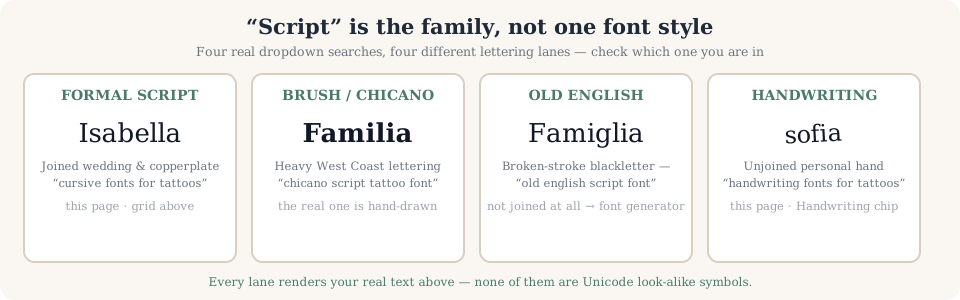
Joined script = what most people mean
Formal copperplate and wedding scripts (“cursive fonts for tattoos” stream) live in the grid above. Thick-thin contrast is the whole look — and the whole risk: hairline upstrokes are the first thing ink spread erases. Judge them with the fade test, not at poster size.
Chicano “script” is lettering, not a font file
“chicano script tattoo font” ranks because people want the West Coast look. Font shops sell you a static approximation; the real thing is drawn by a lettering artist per word, with ligature options a typeface cannot have. Use the grid’s brush lane as a direction to hand a shop — and be quoted for hand-drawn work, not flash.
Old english is script by habit, blackletter by construction
“old english script font tattoo” is a top dropdown, but Fraktur letters never join — they are broken strokes with spurs. That matters: blackletter survives at small sizes better than fine script because its weight is even. If that is your lane, the blackletter faces are on the tattoo font generator grid.
Handwriting is a person, not a style
“handwriting fonts for tattoos” and the mom-handwriting stream split again: a loose unjoined hand can be rendered (Caveat and Homemade Apple above), but a specific person’s writing cannot — that is the photo-transcription path, honestly answered in the FAQ below.
Why Half the “Cursive Font” Results Online Are Not Fonts
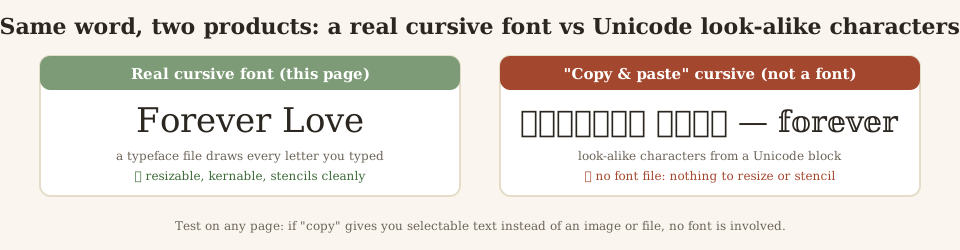
The tell is a Copy button. Top-ranking pages for cursive fonts for tattoos show your word in elegant script — then “copy” hands you characters from Unicode’s mathematical-alphanumeric block: 𝓢-lookalikes that happen to resemble script. One popular generator’s own interface prints “Copies as:” followed by exactly such a string under every “font.” If copying gives text instead of an image or file, no typeface is involved.
Why an artist can’t stencil a Unicode bio font: there is no font file behind those characters, so nothing to resize, kern or trace; half of phones render them as tofu boxes; and two “styles” of them are literally the same letters from different code blocks. Send one to a shop and the reply will be a redraw from scratch — priced as custom lettering.
What is genuinely fine to copy-paste: social-media bios and gamer tags, where you just want stylised text. The tattoo font generator keeps that lane split from real rendering too — this page is the cursive branch of the same honest rule.
“For Men” and “For Names” Are Different Cursive Problems
Autocomplete feeds both searches the same generic lists. The families that win in each lane barely overlap — so the grid above ships filter chips instead of one blended stack.
The names / wedding lane
Flowing connected scripts (Great Vibes, Pinyon, Italianno) for partner names, dates and vows. Risk concentrates in ornate capital swashes that dominate the word — judge the lowercase, not the initial letter.
Test: type both names side by side in the grid at 32px. If a script needs a caption to be read, it needs a bigger quote — size is the style.
The men / bold lane
Heavy brush and retro scripts (Kaushan, Pacifico, Alex Brush) carry the Chicano-lettering look searches for “cursive fonts for tattoos men” actually want — plus fine-line single words for the restraint direction.
Test: bold lanes survive small sizes best; use the fade test in the How-To below before ruling out an elegant script for a small piece.
Three Things a Cursive Font Grid Can’t Decide for You
1. Real handwriting isn’t a font. A large share of “mom handwriting tattoo” searches ends on font pages by accident. Her actual letters exist on one birthday card — the path is photograph it, run it through the photo input on the AI generator, and let the artist trace what the render suggests. No typeface should replace her looped g.
2. Screen size isn’t skin size. A 44px script breathes on a laptop; stamped at 40mm across a wrist its connectors fill in. That is why this grid keeps a size slider and a fade test — and why step four is putting your pick on a real photo of the spot in the tattoo simulator.
3. Aging is cursive × placement, not cursive alone. Fine scripts fail faster on high-friction, high-movement skin. The same word in the same face reads clean for years on a flat outer forearm (rated 2–4/10 pain, low friction) and softens early on a watch-rubbed inner wrist (5–7/10). Check the skin side in the placement chart before you lock the font.
Not just cursive?
Blackletter, Roman caps, typewriter and more — the full 12-font generator with the Unicode-truth split.
Cursive still scaring you?
Ten real questions — aging, fading to green, small-piece cost — answered honestly in under 80 words each.
Font picked? Size it on your skin
Screenshot the winner, upload the spot, judge real centimetres free.
Letters decided? Make it transfer-ready
Clean the reference into a high-contrast stencil outline for your artist.
Is it a name you’re choosing for?
Names need extra audits — capital, letter pairs, vertical vs horizontal — on the dedicated fonts-for-names page.
Cursive Questions People Actually Type
What is the best cursive font for a tattoo?
For most names and short phrases: a moderate-contrast connected script — Sacramento and Great Vibes in the grid above hold their shape at sizes a needle can actually follow. “Best” lists online rank by how pretty the lettering looks at poster size; on skin the ranking flips, because hairline upstrokes are the first thing ink spread erases. The honest test is your own word at your own size — type it above, drop to 28px, and any font whose double letters merge is out.
Do cursive tattoos age well?
The ones with weight in the strokes, yes. Cursive ages as a product of three factors: stroke contrast (high contrast fades unevenly), letter spacing (tight loops merge as ink spreads) and placement (a script on an inner wrist sits in a watch-friction zone; the same script on a flat outer forearm holds years longer). Casual scripts with even weight outlive ornate copperplate at the same size. Our placement chart has the friction data per spot.
Do cursive tattoos fade?
All tattoos fade — cursive just fails visibly sooner, because when a script loses 20% of its hairlines it stops being readable words, while a bold line just gets softer. The mechanism is ink spreading a fraction of a millimetre under skin over years. The defence is decided at the design stage, not after: one step larger than it feels like, extra letter gap, and asking your artist to thicken the thinnest strokes before the stencil is cut.
Which cursive fonts work for guys' tattoos?
The “cursive fonts for tattoos men” search splits into two real camps. Heavy bold scripts — brush styles like Kaushan and retro diner faces like Pacifico — carry the Chicano/gangster lettering tradition and stay readable at small sizes. The other camp is restraint: a single fine-line word in a casual script. What rarely works is wedding-invitation flourish sets, which is why the filter chips above include a bold lane. Same renderer, honest previews for both directions.
Can a tattoo font generator copy my mom's handwriting?
A font generator cannot — and this is the quiet half of cursive searches, the “mom handwriting tattoo” stream. Your mother’s handwriting is not a font file; no typeface contains her looped lowercase g. The working path is different: photograph a real note of hers, use the photo input on our AI generator to convert the actual lettering into clean tattoo linework, preview it on your skin, and bring the reference to the shop. That’s a transcription job, not a font job.
How much does a cursive tattoo cost?
Lettering bills like any other tattoo — by artist time, not by style — but clean cursive is skilled work, so good lettering prices above same-size pictorial flash at many shops. A small one-word script runs shop minimum in most markets; a forearm-sized quote is quoted in hours. Two things push the number up: redrawn-by-hand lettering (you are paying for skill, worth it) and touch-ups planned because hairlines went soft. Ask the price per piece before booking, never per font.
What are the types of cursive fonts for tattoos?
Four families, and they behave differently under a needle. Formal copperplate (Pinyon, Italianno): extreme thick-thin contrast, gorgeous, risky small. Wedding scripts (Great Vibes): flowing and legible, the safe default for names. Casual handwriting (Caveat, Homemade Apple): reads as a person’s actual writing, ages forgivingly. Brush and retro (Kaushan, Pacifico): heavy single-weight, the men’s lane and the best small-size survivor. The grid above is labelled by family so you can compare across types.
What font is used for tattoo script?
There is no single official one — the dropdown’s honest answer is a shortlist of what shops actually set. Great Vibes and Allura for wedding-lane names, Pinyon for copperplate requests by name, Sacramento for narrow fine-line pieces, Kaushan and Pacifico for the bold West Coast look. Old-school shops draw lettering by hand instead of pasting any of these; a font file is a direction, not a stencil. Type your word above and the same shortlist renders live at your size.
Are script tattoos a bad idea?
Not as a family — as a size decision. Script fails when people scale an ornamental joined face down to a finger or behind-the-ear piece: hairlines merge and the word becomes a smudge in five to ten years. It works when you keep weight in the strokes (brush and casual lanes), go one size larger than the mockup suggests, and pick low-friction skin. The parallel dropdowns “are word tattoos a bad idea” and “are text tattoos a bad idea” ask the same question about legibility, and the answer is the same test: your exact word at your real centimetres.
How to choose a tattoo font?
Start with the real text, never the alphabet. Type your actual name or quote — a font that flatters “A” can murder “Amelia” (swash caps collide, double letters merge). Then filter to two lanes you like, run the fade test at your target size with extra letter gap, and put the finalists on a photo of the placement in the simulator. Style preference is the last filter, not the first: legibility at your size outranks prettiness at poster size.
Two scripts you like? Put them on your arm
One photo of the spot, both screenshots, real centimetre size. Free, no sign-up.
Open the Simulator