Tattoo Font Generator — See Your Words in 12 Real Fonts
A tattoo font generator renders the exact words you type — a name, a date, a short quote — in lettering styles used by tattoo shops, so you can compare before booking. The version above the fold does it with twelve open-licensed typefaces, live in your browser, free and with no account. One honest warning first: many pages by this name hand you Unicode symbols or AI-drawn images, and neither is something an artist can stencil.
Rendered with real open-licensed typefaces, drawn in your browser. Nothing is uploaded, nothing is stored. Loading fonts…
Found the one it should be? Screenshot it at your slider size, then put the lettering on a photo of your skin — screen size and skin size are different questions — and hand both files to your artist via the stencil generator.
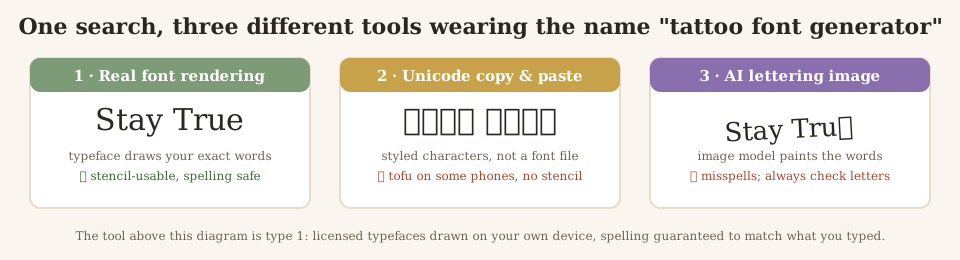
“Tattoo Font Generator” Is Three Different Tools Wearing One Name
Scroll the first page of results and you are mixing three products that autocomplete never separates — “generator,” “copy and paste,” and AI lettering are all dropdown realities. They fail in different ways. Here is the fork nobody on the first page draws for you.
1 · Real font rendering
A licensed typeface draws your exact characters — every letter, accent and space guaranteed to match what you typed, at any scale, with adjustable spacing. This is the only kind that becomes a reference an artist can work from.
Use it when: the words matter (names, dates, vows). The grid above is this kind — and it exports clean into the stencil workflow the same way any flat artwork does.
2 · Unicode copy & paste
Those fancy bios are not fonts — they are lookalike Unicode characters from a mathematical-symbols block that merely resemble blackletter or script. Paste one into a note and half your friend’s phones show tofu boxes; an artist cannot resize, kern or stencil it because no font sits behind it.
Fine for social bios. Wrong for ink. If you arrived searching “tattoo font generator copy and paste” expecting a stencil, this paragraph is why we split the lanes.
3 · AI lettering images
An image model paints your words as artwork. Genuinely useful for decorative pieces — roses woven through script — but models still misspell, especially accents and unusual names. Every AI lettering page should be checked letter by letter, then re-drawn by hand.
Use it when: you want lettering fused into a design. Generate the artwork in the AI tattoo generator, then verify every character.
What a Font Grid Can’t Tell You (The Artist’s Side)
Most good lettering tattoos are not fonts at all. Shops that take lettering seriously redraw your words by hand to follow the curve of the body part. A screen render is a direction — weight, mood, proportions — not a stencil to print and copy. Bring two references rather than one; artists combine strengths far better than they obey orders.
Screen size is not skin size. A 44px script reads open on a laptop; at 40mm across a wrist it can close into texture. That is why the grid keeps a size slider, and why the next step after picking a font is putting the lettering on a real photo of the spot — in the tattoo simulator, free, at centimetre scale.
Aging is a font × placement product. The same fine script that survives years on a flat outer forearm (2–4/10 pain, low friction) blurs visibly faster on a watch-rubbed inner wrist (5–7/10). The font grid shows you the type’s side of that multiplication; the placement chart shows the skin’s side.
Font picked? Size it on your skin
Screenshot the winner, upload the spot, judge real centimetres free.
Letters decided? Make it transfer-ready
Clean the reference into a high-contrast stencil outline for your artist.
Lettering inside a bigger design?
Browse AI generated tattoo designs — banners, scrolls, name pieces with ornament.
Only want script or cursive?
A dedicated 12-face script grid — the four script lanes separated (wedding, fine-line, handwriting, bold), with fade-test guidance.
Choosing a font for a name?
The names page — capital and letter-pair audits, vertical vs horizontal, real-size rules for a specific word.
Font Questions People Actually Type
Is this tattoo font generator free?
Yes — free online, no account, no watermark, no credit meter. The renderer above is the same on every tier because it runs entirely in your browser: your text is never uploaded, so there is no per-use cost for us and no reason to charge. That is a different kind of “free” than the apps that bill the word “free” to their install button and then ask for credits before showing one result.
What is the best tattoo font?
There is no single best, and any page claiming one is selling something. The honest ranking rule used by lettering artists: legibility at your size beats style at any size. Blackletter and heavy scripts close up when small; fine-line scripts fade fastest on high-friction spots like the inner wrist. For first tattoos, open counters and moderate contrast age best. Try your exact words in the grid above — the test is your text, not the alphabet.
Which cursive fonts work for tattoo names?
The name searches pull three families: connected script (Great Vibes, Alex Brush in the grid above), fine monoline script (Sacramento) and brush script (Caveat, which reads as handwriting rather than calligraphy). The catch with cursive on skin is hairlines — the thin upstrokes are the first thing to blur within five to ten years. The practical fix: size it one step larger than feels necessary and add letter gap, which is exactly what the two sliders above let you test.
Can I get copy and paste tattoo fonts for my bio?
You can — but know what you are holding. That style of “font” is Unicode symbols, not a typeface: pretty in an Instagram bio, unreliable across Android and iPhone, and useless to a tattoo artist because it is not a font file, has no adjustable spacing, and scales as text rather than artwork. When you search tattoo fonts for names you will get both kinds mixed on one page; this page keeps them in separate lanes. Use copy-and-paste for the bio; use a real font render for the ink.
Which tattoo font ages best?
High-contrast, open shapes with strokes thick enough to survive line spread: traditional flash lettering (Rye), Roman capitals (Cinzel) and heavy blackletter hold up for decades. Delicate serif and hairline script go the other way — they are the styles artists warn about most. Placement multiplies the effect: a fine script on the inner wrist sits in a watch-friction zone (our wrist guide rates it 5–7/10 pain, high visibility) while the same letters on the outer forearm (2–4/10, flattest canvas) age considerably better. Font and spot are one decision, not two.
What font is used for tattoos?
There is no one official tattoo font — the search “what font is used for tattoos” returns the styles shops set most: Old English / blackletter for statements and surnames, script and calligraphy for names and dates, typewriter and Roman caps for quotes and coordinates, and American traditional lettering (Rye-style) for flash banners. Most professional artists do not paste a computer font anyway: they draw the lettering by hand to fit your body’s curve. A font render is a direction to hand them, not the stencil itself.
How do I use a tattoo font generator for names?
Four steps: type the exact name including any accents and middle initial; compare renders side by side and eliminate anything that closes up or breaks a letter connection you like; raise size and letter gap until the smallest letters stay open; then screenshot your favourite two and put them on a photo of the intended spot in the simulator. Two references beat one because a good artist will combine the strengths of both into the hand-drawn final.
Two fonts you like? Put them on your arm
One photo of the spot, both screenshots, real centimetre size. Free, no sign-up.
Open the Simulator