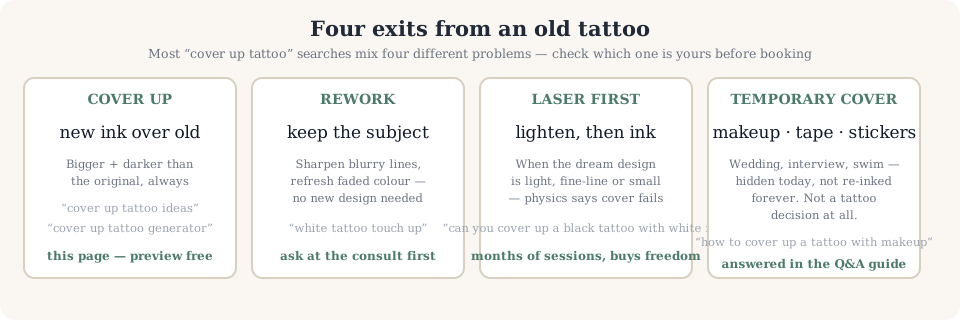
Can you cover up a tattoo with skin colored ink?
No. Tattoo ink sits in the dermis like tinted glass, not like paint on canvas — skin-tone pigment over dark lines heals into a muddy grey smear with the old shape still glowing through. Flesh-tone ink has one real job: paramedical camouflage on un-tattooed scar tissue. If your goal is invisible-today rather than re-inked-forever, that is a makeup question, not a tattoo question — see the makeup answer below.
Can you cover up a black tattoo with color?
Only colours dark and saturated enough to out-ink the black: deep blue, purple, forest green, blood red. Pastels, yellows and brights read transparent over solid black once healed — the old lines ghost through within weeks. The dependable pattern artists use is a black-and-grey base that swallows the original, then colour built on top of that. Budget it as multi-session work, not one afternoon.
Can you cover up a tattoo with white ink?
Not as a cover. White over existing pigment turns grey-green and lets the old outline show — it lifts highlights, never hides lines. Genuine uses of white in a cover-up: contrast inside a new dark design, or softening the edge where new ink meets old. If someone quotes you a “white ink cover-up” that hides black in one session, that is physics they are ignoring, not a technique you missed.
Can any tattoo be covered up?
Most can — the honest exceptions are cases where “coverable” technically means “now twice the size”. Dense solid black, old colour with many layers, and tiny spots with no room to grow (fingers, behind the ear) often push the required cover beyond what you want on your body. That is when the answer changes from cover-up to laser-first. Size, darkness and body area decide; the subject matter almost never does.
Does a cover up tattoo hurt more?
Usually a bit — same pain, arriving sooner. You are needling skin that has already been needled, over denser pigment that takes more passes, often in a longer session. Most people describe it as increased sensitivity and fatigue in the area rather than a different kind of hurt. Where it sits on your body matters more than the fact of covering: check the per-spot pain ratings in our placement guides before assuming.
Can you cover up a cover up tattoo?
Sometimes — and it gets harder every round. The second cover-up needs new room: more size, more darkness, or laser sessions to thin the layered stack underneath. If the first cover already stretched across extra skin, a third pass may end up somewhere you never wanted to be tattooed. Preview candidates over the current state first and bring realistic options to a specialist consult.
How much is a cover up tattoo?
More than fresh work of the same size, for three concrete reasons: custom design time around an existing piece, denser passes and longer sessions, and a specialist premium — cover-up artists price above standard flash hours. Expect shop minimums on small pieces regardless of centimetres, hourly quotes that run long on sleeves, and a likely touch-up session after healing. Ask the policy before the price conversation, not after.
How to cover up a tattoo with makeup?
Layer, don’t glob: colour-correct first (peach/orange cancels blue-black pigment), then a full-coverage matte concealer matched to your skin, stippled in thin layers and heat-set with powder between each. The failure mode is a thin single coat that shifts when you bend your arm. Build in daylight, let each layer set, and set the final layer with translucent powder. Same principle for long days: product quality beats product quantity.
How to cover up a tattoo temporary?
Three honest tiers for a day, not a life: high-coverage makeup (best colour match, practises needed), adhesive concealers — tape or patches sized to the spot (fast, waterproof options exist), and printed temporary cover sleeves for large limbs (photo-realistic, matched to skin tone and area). For weddings, interviews and pool days, any of these work for twelve-ish hours. None of them is a tattoo decision — keep this page’s four exits for that.
How to design a cover up tattoo?
Work the constraints, top to bottom: photograph the old ink flat-on with a ruler; accept that the cover needs to run bigger and darker than the original; pick a subject whose natural shapes absorb the old lines (florals, fur, feathers, waves swallow stray edges; rigid geometry does not); route the composition along the original’s shape, not against it. Then preview candidate designs over your own photo before anyone books a chair.